Watching The Trends, Trusting Our Instincts
Industry trends don’t have a sense of season. Often, these trends happen as an interesting idea begins to garner unexpected results. Or they happen because hype, earned or not, begins to dominate the conversation.
Regardless, it’s our responsibility, both as curious professionals and as stewards of our clients’ strategies, to keep our ears to the ground and our fingers on the pulse of what’s happening in the marketing world.
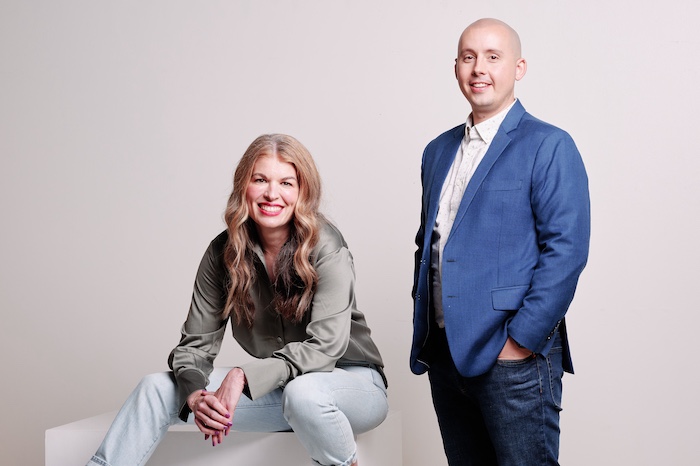
I sat down with our founders, Meghan and Garrett, to get a sense of what is capturing their attention, what they’re excited about, and what they might be cautious of.
Q: Are there any marketing, business, or industry trends that you guys have noticed lately that you’re excited about or, inversely, cautious of?
Meghan: Yeah, I mean, maybe one that I’m both excited about and cautious of is the idea that the CEOs or Founders should really lean into their own personal brand voice when marketing the business, and that it’s okay if that voice isn’t perfectly scrubbed.
She doesn’t need to ensure that everyone loves her. It’s liberating, but also creates a completely different kind of pressure.
The word authentic gets used a lot, so I hate to use it, but I like having that voice that is not perfectly polished, because that’s reality.
Every once in a while, I’ll post something that has a typo or a grammatical error, and that used to fill me with anxiety, but the truth is, I think that it’s a positive reminder that there’s a human behind what I’m doing — that there are humans behind what we’re doing.
People, incredibly creative and talented humans, are central to the way that we operate, and when you work with us, you’re going to be engaging with people who care about you as a human, the success of the campaigns that we run together.
So, yeah, I’m seeing that there’s an increase in businesses making the effort to personify the work that they’re doing — to pair the output with the people doing the input — and I like that I get to embody that for Formada.
When The Trends Get Forced Into Your Work
Garrett: I mean…it’s hard to answer this question without talking about AI, right?
It’s funny, because everything I’m thinking of, there are layers of how AI is impacting things, because obviously that’s the trendiest thing.
But let me be specific, because it’s not like AI writ-large that I’m talking about. It’s specific things within AI that I’m concerned about.
One trend I’m very cautious of and very uncomfortable with, is how all of the software that we use is trying to force AI into its makeup. This has two-fold problems, in my opinion.
First, what if I want to opt out of using AI? Like, what if I’m not interested in using this feature?
Just a few weeks ago, we’ve been struggling with the fact that Meta apps are like, “Check out this amazing tool! You wrote your own original copy, and now we’re going to rewrite it!”
And it’s done by default. You don’t have a choice. So, then you have to manually turn it off and say, “I don’t want to use that.” This automatic opt-in culture for AI is very frustrating to me.
There’s also the cost that comes with this. Companies are suddenly charging you an additional $5 to $20 per seat to use AI features you don’t necessarily want. It feels more like a cash grab than a benefit.
Astroturfing Trends, Monetizing The Outcomes
The second part of this that concerns me is that these platforms are incentivizing users to adopt these AI features.
Google and Meta Ads, all these platforms right now, are saying to their clients, “You know, this is doing well, but we would give you 7% more impressions if you were using the AI features.”
Does it mean it’s better for the user? Absolutely not. They appear to be intentionally throttling results to increase feature adoption, and what it ultimately means is that they can go back to their shareholders and say, “Wow. This might seem weird, but 80% of users are now using the AI features in our platform overnight! We don’t know how it’s happening.”
In my estimation, it’s all about getting more training data, showing an increase in daily users, and proving the use case for AI.
It sucks. We can’t really pull out of it. Cause I think there are plenty of good uses for AI. I just don’t like being forced to use a tool a certain way.
For instance, we have a really good project management system. They’re on the cusp of rolling out the newest version, and rather than having us opt in $8 per user to use AI features, they just stuffed it in there and made a mess of the whole layout.
To me, that’s a huge issue for small business owners, because all of the sudden, you have to change plans, figure out a different software platform, and make that transition. It’s a burden.
On the marketing trend front, I’m not super concerned about a total AI takeover, because I think you saw, like with that Coca-Cola holiday ad, people hated it. They don’t like it, they don’t want it. There was a huge, negative reaction.
I feel more encouraged as a creative and as a marketer that the quality of human driven content is what matters, long-term. Do I trust the software companies? No. I trust the consumers.
A New Celebration Of Hand-Made Artistry
I guess, as a reaction to this, maybe the part I’m excited about is that I think we’re seeing greater value placed on things that are handmade or human driven.
Apple TV has a new intro tag, like the Netflix tu-dum, and it’s this beautiful little frame by frame, colorful thing that introduces the brand. They even did a brief documentary ad showing how it was created by the team of artists behind it.
I mean, could someone have just plugged some prompts into an AI generator? Sure. But it’s really not the same. And you see how differently people reacted to the Apple TV spot vs. the Coca-Cola ad.
People love the Apple TV spot. It went viral. People talked about it a ton. Then you see the Coca-Cola ad. People hated it so much that they ended up pulling it.
Consumers are having a very specific reaction to AI. They have specific expectations of it. I’m excited about that. I don’t think it’s been fully embraced at the executive level yet. I don’t think it’s at the shareholder or tech-bro level. We’re a ways off on that, because they’re all so heavily invested in it, but I think we’re seeing a retaliation from consumers. I want to see more of that.
And selfishly, that puts us in a better position, because we put an emphasis — a premium — on people. I don’t see us changing that. We’ll continue to do that indefinitely.
I’m excited about that. It feels encouraging to me.
The Freedom To Say What We’re All Thinking
Meghan: What Garrett is saying spurred something else that’s been on my mind lately.
I don’t know if this is an industry trend or whatever, but my favorite types of entrepreneurs to follow are those people who speak to their audience the exact same way that they’d speak to you if you were to sit down at their kitchen table.
They’re not over-sharing. And they’re not watering down how they feel about something that is clearly like a major challenge for most people, like navigating insurance or some other huge institutional challenge that people often face.
It makes me think about this guy that I follow on LinkedIn, a pretty powerful attorney, and one of the things that he’s been talking about a lot lately is insurance premiums, his experience as an employer with insurance premiums, and how unfair the insurance system is.
He’s in a position where he has the money to pay a good chunk of his team’s premiums. He sees that a lot of small businesses can’t do that — not because they don’t want to, but because of the way that insurance is designed to be very difficult to get even get a plan, and then even more difficult to actually use.
I guess my point is that I admire these people who are in prominent positions in their industries and are willing to say these things out loud. It shouldn’t be so refreshing, but it is.
Garrett: Yeah, Meg. It’s the authenticity piece, isn’t it? It really is a sticking point for me. It also goes hand in hand with the AI thing.
The people who were producing slop before are still producing slop, but they’re using AI to churn it out.
It puts a higher focus on the actual, authentic people who I can trust and the quality of the work that they’re doing.
I went to the bookstore the other day, and book covers are always interesting to me, because that’s like, heavy, heavy marketing, right? We usually think of them as a super elevated artform, but those book covers are often what gets you to read the blurb — maybe even buy it.
What I’m noticing is that the quality of book covers right now has massively spiked. The graphic design work is phenomenal. And because there is so much slop, so much mass-produced garbage, you really have to do something unique to break through the clutter and the noise.
We’re seeing so many interesting takes on things, because people are creating things that are very different. Separating the wheat from the chaff.
In a way people never really have before, people are actually putting intent into caring about “What’s the source of this? Who’s creating this? Is this a unique idea?”
And then they value it in a different way. I find myself trusting voices in the marketing world a lot more than I used to. I aspire to be one of those voices to our clients and to the industry. That’s a worthwhile goal.
Trends Come And Go. Quality Endures.
No matter which direction industry trends may lead, your business needs an agency that is dedicated to your goals, your growth, and your success.
Formada is proudly just that — a marketing agency built on the proven idea that great work, created by people for people will always lead to the best possible outcomes.
Interested in learning more about how our work and your goals might mesh? Contact us today! We’d love to help you grow.